
Coronary artery bypass grafting (CABG) — commonly called heart bypass surgery — is one of the most common major surgeries performed in the world. In India, over 80,000 bypass operations are performed every year. Despite its frequency, the words 'bypass surgery' are among the most frightening a patient can hear. This guide is designed to replace fear with clear, factual information so that patients and families can prepare, understand, and recover confidently.
Key Takeaways
- Bypass surgery reroutes blood flow around blocked arteries using a graft vessel — the heart itself is not replaced
- Most patients are in the intensive care unit for 1–2 days, then the general ward for 5–7 days
- Full recovery takes 1 - 2 months for most patients — returning to driving at 4 - 6 weeks, work at 4 - 6 weeks
- Bypass surgery does not cure heart disease — lifestyle changes are essential to protect the grafts
- SRM Prime Hospital's cardiac surgery team performs both on-pump and off-pump (beating heart) bypass surgery
What Is Heart Bypass Surgery and Why Is It Done?
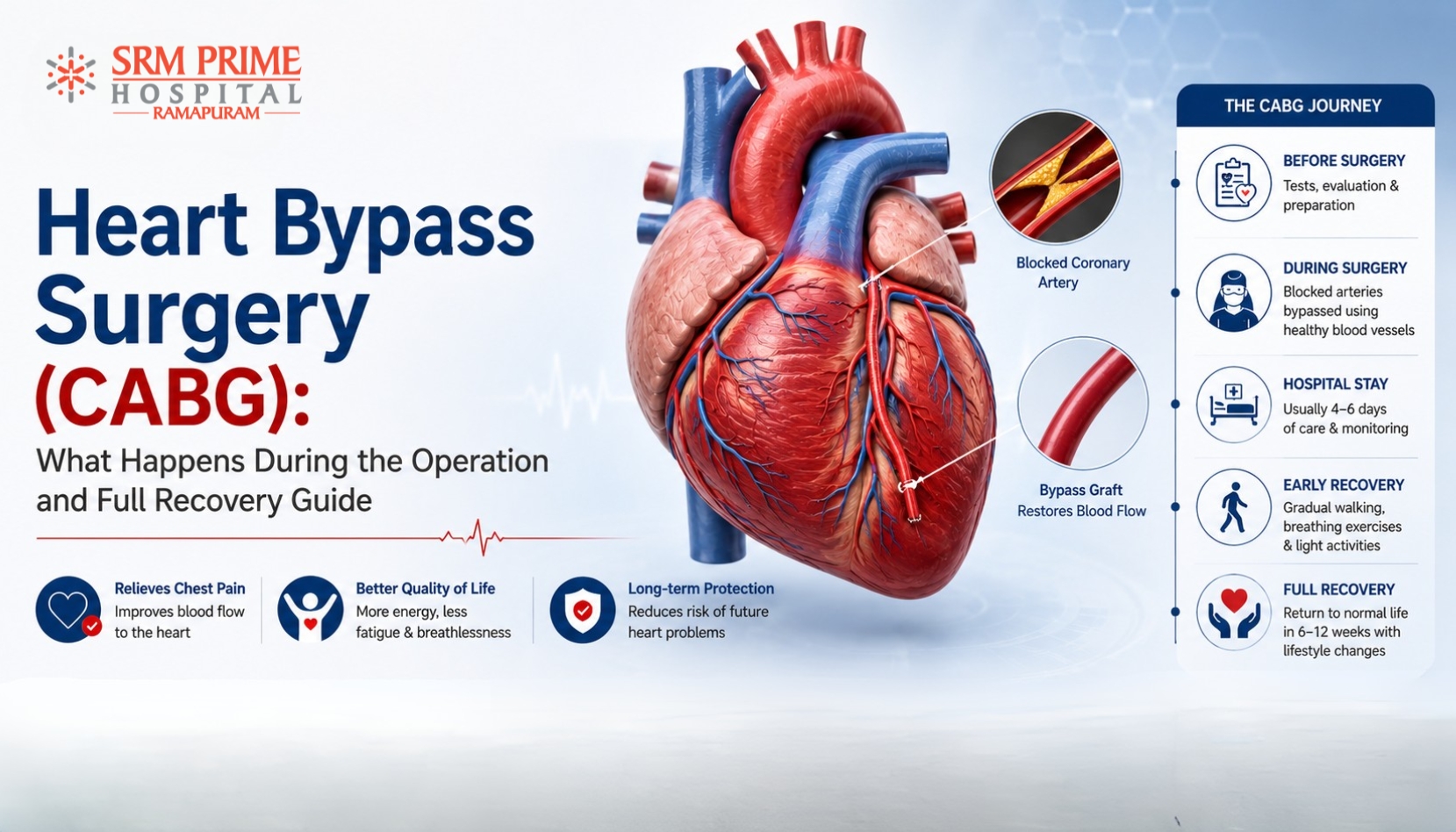
Coronary artery disease (CAD) occurs when the arteries supplying blood to the heart muscle become narrowed or blocked by atherosclerosis (fatty plaques). When blockages are severe, the heart muscle does not receive enough blood — causing angina (chest pain), heart attacks, and heart failure. Bypass surgery creates a detour (bypass) around the blocked artery using a healthy blood vessel (graft) taken from elsewhere in the body — typically the leg (saphenous vein), chest wall (internal mammary artery), or arm (radial artery).
When Is Bypass Surgery Recommended Over Angioplasty (Stenting)?
Bypass vs Angioplasty – Key Factors
- Number of Blocked Arteries3 or more vessels: Bypass is generally preferred.
- 1–2 vessels: Angioplasty/stenting may be preferred.
- Left Main Artery DiseaseBypass: Strongly preferred in many cases.
- Stenting: May be suitable for selected patients.
- Diabetes with Multi-Vessel DiseaseBypass: Often provides better long-term outcomes.
- Stenting: May be considered depending on the individual case.
- Severity of BlockageLong or complex blockages: Bypass may be preferred.
- Short or simple blockages: Stenting may be preferred.
- Heart FunctionReduced EF: Bypass may provide greater overall benefit.
- Preserved EF: Both bypass and angioplasty may be viable options.
What Happens During Bypass Surgery?
Bypass surgery is performed under general anaesthesia and typically takes 3–5 hours. In conventional on-pump CABG, the heart is temporarily stopped using a cardioplegia solution and the patient is connected to a heart-lung bypass machine that takes over circulation. The surgeon then sews the graft vessels onto the coronary arteries beyond the blockages. The heart is restarted, the bypass machine is disconnected, and the chest is closed. Off-pump (beating heart) bypass avoids the heart-lung machine — our surgeons will recommend the most appropriate technique for your case.
Recovery After Heart Bypass Surgery — Timeline
- Day 1–2: ICU monitoring. Breathing tube removed (usually within hours of surgery). Start sitting up.
- Day 3–7: Moved to general ward. Walking short distances with a physiotherapist. Deep breathing exercises critical to prevent lung complications.
- Day 7–10: Discharged home (if recovery is uncomplicated). Cardiac rehabilitation begins.
- Week 2–4: Home rest and supervised walks. Avoid lifting more than 2–3 kg. Sternal wound care.
- Week 4-6: Driving resumes (after sternal healing confirmed by surgeon). Return to desk work.
- Month 1-2: Most patients return to work and feel significantly better than before surgery.
Warning signs after bypass surgery — seek urgent care:
- Increasing chest wound redness, discharge, or opening
- High fever above 38.5°C
- Rapid weight gain (more than 1–2 kg overnight) — fluid retention
- Worsening breathlessness or leg swelling
- New or worsening chest pain
Life After Bypass Surgery — Protecting Your Grafts
- Medications: blood thinners (aspirin), statins, blood pressure tablets, and other medications are essential — do not stop without medical advice
- Quit smoking permanently — smoking is the single biggest threat to graft patency
- Heart-healthy diet: low saturated fat, low salt, high fibre, Mediterranean-style eating
- Regular exercise: cardiac rehabilitation programme, then 30 minutes of walking 5 days a week
- Diabetes and blood pressure control: protect the grafts and slow atherosclerosis
- Regular cardiology follow-up: annual review with ECG and echocardiogram
Your family member needs heart surgery? Our cardiac surgery and cardiology team at SRM Prime Hospital are available for urgent consultations 24/7. Call 044 3545 3545.
Book Appointment: srmhospitals.com | Call: 044 3545 3545 | Emergency: 044 3500 3500
Frequently Asked Questions (FAQ)
How long do bypass grafts last?
Internal mammary artery grafts (the best quality graft) remain open (patent) in over 95% of patients at 10 years and 85–90% at 20 years. Saphenous vein grafts have a lower patency — approximately 50–60% at 10 years — which is why lifestyle changes and medications are critical after surgery.
Will I feel better immediately after bypass surgery?
Most patients feel significantly better — more energy, less breathlessness, and less or no chest pain — within 4–8 weeks of surgery. However, recovery from open heart surgery takes time, and the first 2 weeks can feel slow. The improvement becomes noticeable as the weeks progress.
Can bypass surgery be done without stopping the heart?
Yes. Off-pump coronary artery bypass (OPCAB) — also called beating heart surgery — is performed without connecting to the heart-lung machine. SRM Prime Hospital's cardiac surgeons are experienced in both on-pump and off-pump techniques. Your surgeon will recommend the approach best suited to your anatomy and overall condition.
Is bypass surgery safe for patients in their 70s and 80s?
Yes, with careful patient selection and management. Age alone is not a contraindication to bypass surgery. Older patients may have longer hospital stays and need more intensive rehabilitation, but the outcomes of bypass surgery in carefully selected older patients remain very good.
What is the success rate of heart bypass surgery in India?
At experienced centres, the in-hospital mortality for elective CABG is less than 1–2% for patients with normal or near-normal heart function. For emergency or complex cases, risk is higher. SRM Prime Hospital's cardiac surgery programme follows international quality benchmarks with outcomes data tracked prospectively.






-vs-ESWL-Which-Procedure-is-Right-for-You.webp)




.webp)
.webp)

.webp)
+(1).webp)
.webp)