

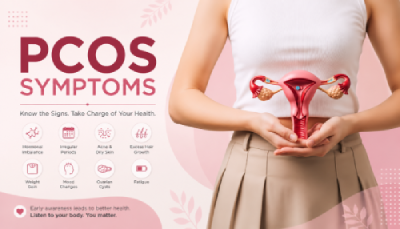
Polycystic Ovary Syndrome (PCOS) is one of the most common hormonal disorders in women of reproductive age, affecting 1 in 5 Indian women. Despite being so common, it is frequently misdiagnosed or dismissed. Understanding PCOS — its symptoms, causes, and how to manage it — is essential for every woman's health.
Key Takeaways
- PCOS is not just about irregular periods — it affects metabolism, fertility, and mental health.
- Losing just 5–10% of body weight can significantly reduce PCOS symptoms.
- PCOS is a leading cause of female infertility — but most women with PCOS can conceive with treatment.
- Early diagnosis and management prevent long-term risks including type 2 diabetes and heart disease.
What Are the Symptoms of PCOS?
- Irregular, infrequent, or absent periods (fewer than 8 periods a year).
- Heavy or prolonged bleeding during periods.
- Excess facial or body hair (hirsutism) — upper lip, chin, chest, abdomen.
- Acne — particularly jawline, chin, and cheeks — that does not respond to usual treatments.
- Thinning hair on the scalp (female pattern hair loss).
- Weight gain — especially around the abdomen.
- Darkened skin patches on the neck, armpits, or groin (acanthosis nigricans).
- Difficulty getting pregnant.
- Mood swings, anxiety, or depression
What Causes PCOS?
The exact cause is unknown, but PCOS involves a combination of insulin resistance (where cells do not respond properly to insulin, leading the body to produce more), elevated androgen (male hormone) levels, and genetic factors. Urban lifestyle factors — stress, poor diet, inactivity, and sleep disruption — worsen PCOS significantly.
PCOS and Fertility
PCOS is the most common cause of anovulation (failure to ovulate) and accounts for around 70% of female infertility due to ovulatory problems. However, it is absolutely not a sentence of infertility. Most women with PCOS can ovulate and conceive — sometimes with simple lifestyle changes, sometimes with medications like letrozole or metformin, and when necessary with IUI or IVF.
PCOS Diet and Lifestyle Management
- Follow a low glycaemic index (low GI) diet — favour whole grains, legumes, vegetables, and lean protein over refined carbohydrates and sugar.
- Exercise for at least 150 minutes per week — even brisk walking improves insulin sensitivity markedly.
- Prioritise sleep — sleep deprivation worsens insulin resistance and hormonal imbalance.
- Manage stress — chronic stress elevates cortisol, which worsens androgen levels.
- Even 5–10% weight loss in overweight women with PCOS can restore ovulation and regular periods.
Concerned about irregular periods, excess hair growth, or difficulty conceiving? Our gynaecology and endocrinology team at SRM Prime Hospital offers comprehensive PCOS evaluation and treatment.
Book an Appointment: srmhospitals.com | Call: 044 3545 3545
Frequently Asked Questions
Is PCOS curable?
PCOS is a chronic condition without a definitive cure, but its symptoms can be effectively managed with lifestyle changes and medications. Many women find their symptoms improve significantly with the right treatment plan.
Does PCOS always cause infertility?
No. While PCOS is a common cause of difficulty conceiving, most women with PCOS are able to achieve pregnancy — either naturally or with fertility treatments. Early treatment improves outcomes.
What is the difference between PCOS and PCOD?
PCOD (Polycystic Ovarian Disease) and PCOS are often used interchangeably in India. Technically, PCOS refers to the full syndrome with hormonal imbalance, while PCOD may refer more narrowly to the presence of multiple cysts on the ovaries. PCOS is considered a more serious condition.
Can unmarried women have PCOS?
Yes. PCOS is a hormonal disorder that affects women regardless of marital status. Irregular periods, acne, weight gain, and excessive hair growth can all occur in young, unmarried women with PCOS.
What specialist should I see for PCOS?
A gynaecologist is usually the first point of contact. Depending on symptoms, you may also need an endocrinologist for metabolic issues, a dermatologist for skin and hair concerns, or a fertility specialist if conception is a goal.






-vs-ESWL-Which-Procedure-is-Right-for-You.webp)



.webp)
.webp)

.webp)
+(1).webp)
.webp)