
In modern medicine, not all treatments require large incisions, long hospital stays, or extended recovery periods anymore. One of the most transformative advancements driving this shift is Interventional Radiology (IR)—a minimally invasive, image-guided approach that is rapidly changing how complex diseases are treated.
From treating blocked blood vessels to managing tumors, interventional radiology is increasingly replacing traditional open surgeries with safer, faster, and more precise procedures.
What is Interventional Radiology?
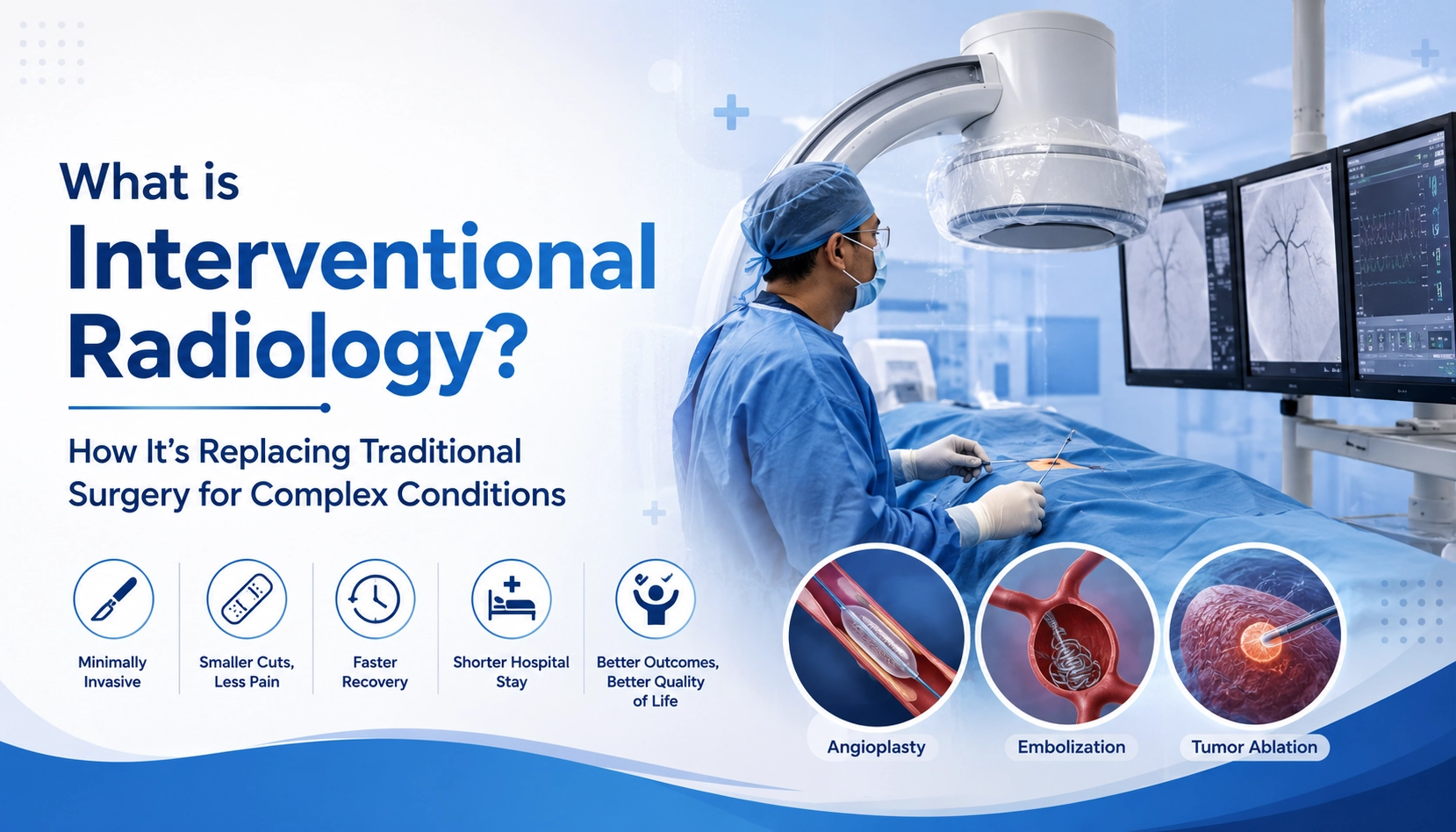
Interventional Radiology is a specialised branch of medicine that uses medical imaging technologies such as X-rays, CT scans, MRI, and ultrasound to guide minimally invasive procedures inside the body.
Instead of large surgical cuts, IR procedures involve:
- Tiny incisions (often just a few millimeters)
- Thin tubes called catheters
- Real-time imaging guidance
This allows doctors to diagnose and treat a wide range of conditions with high precision and minimal trauma to the body.
How Interventional Radiology Works
Interventional radiologists use imaging as a “roadmap” to navigate inside the body. A typical procedure involves:
- Small entry point creation – usually in the wrist or groin
- Insertion of a catheter or needle
- Navigation using live imaging
- Targeted treatment delivery (such as delivering medication, removing blockages, or destroying abnormal tissue)
Because everything is image-guided, doctors can reach deep or complex areas without open surgery.
Conditions Treated by Interventional Radiology
Interventional radiology is used across multiple specialities. Some common conditions include:
- Blocked arteries (Peripheral Artery Disease)
- Stroke prevention and treatment
- Tumors (liver, kidney, lung, etc.)
- Uterine fibroids
- Internal bleeding
- Varicose veins
- Kidney and bile duct obstructions
- Chronic pain conditions
In oncology, IR plays a major role in minimally invasive cancer treatments such as tumor ablation and chemoembolisation.
Why Interventional Radiology is Replacing Traditional Surgery
1. Minimal Invasiveness
Unlike open surgery, IR procedures do not require large incisions, reducing trauma to the body.
2. Faster Recovery Time
Most patients return to normal activities within days instead of weeks.
3. Lower Risk of Complications
Reduced blood loss, lower infection rates, and fewer post-operative complications.
4. Shorter Hospital Stay
Many procedures are done on a day-care or short-stay basis.
5. High Precision
Image guidance allows doctors to target only the affected area, preserving healthy tissue.
Interventional Radiology vs Traditional Surgery
Interventional Radiology
- Requires only a very small incision or needle puncture.
- Offers faster recovery, often within a few days.
- Usually performed as a day-care procedure or requires only a short hospital stay.
- Causes minimal pain with less discomfort after the procedure.
- Has a lower risk of complications, including reduced bleeding and infection.
Traditional Surgery
- Requires a larger surgical incision.
- Recovery can take several weeks to months, depending on the procedure.
- Typically involves a longer hospital stay.
- Associated with moderate to severe post-operative pain.
- Carries a higher risk of complications, such as infection, blood loss, and longer wound healing.
Common Interventional Radiology Procedures
Some widely performed IR procedures include:
- Angioplasty & Stenting – to open blocked blood vessels
- Embolisation – to block abnormal blood flow (e.g., tumors, bleeding)
- Ablation Therapy – using heat or cold to destroy tumors
- Thrombolysis – dissolving blood clots
- Biopsy Procedures – image-guided tissue sampling
- Drainage Procedures – removing fluid from abscesses or organs
Advantages for Patients
Patients undergoing interventional radiology benefit from:
- Less pain and scarring
- Reduced hospital costs
- Lower anaesthesia requirements
- Quicker return to normal life
- Better cosmetic outcomes
The Future of Surgery is Minimally Invasive
With continuous advancements in imaging technology, robotics, and catheter-based tools, interventional radiology is becoming a cornerstone of modern healthcare.
In many cases, it is no longer a question of “open surgery or not,” but rather “can this be treated better with interventional radiology?”
Hospitals with advanced imaging and specialised IR teams are now able to treat conditions that once required major surgery with simple, precise procedures.
Conclusion
Interventional Radiology is redefining modern healthcare by replacing many traditional open surgical procedures with safe, precise, and minimally invasive image-guided treatments. From treating vascular diseases and cancers to managing emergency bleeding and complex organ conditions, IR is helping patients recover faster, with less pain and fewer complications.
As medical technology continues to evolve, hospitals equipped with advanced imaging systems and multidisciplinary expertise are leading this transformation.
One such institution is SRM Prime Hospital, Ramapuram, Chennai. As a quaternary care centre under the SRM Group, the hospital is built on the foundation of advanced infrastructure, cutting-edge imaging technologies, and highly experienced specialists. With facilities such as AI-enabled radiology, smart cath labs, modular operation theatres, and 24/7 emergency care, SRM Prime Hospital is well-positioned to deliver modern interventional radiology and other minimally invasive treatments that align with global standards of care .
By integrating innovation with compassionate care, SRM Prime Hospital reflects the future of healthcare where procedures are less invasive, recovery is faster, and patient outcomes are significantly improved.
Interventional Radiology is no longer just an alternative to surgery—it is rapidly becoming the preferred choice for many complex conditions, and institutions like SRM are at the forefront of this medical revolution.









-vs-ESWL-Which-Procedure-is-Right-for-You.webp)




.webp)
.webp)

.webp)
+(1).webp)
.webp)