

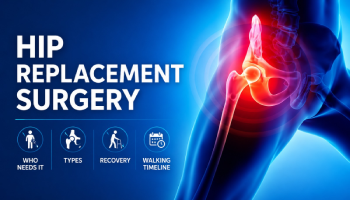
Total hip replacement (total hip arthroplasty) is consistently rated among the most successful surgical procedures for quality-of-life improvement. Patients who once struggled to walk 50 metres or couldn't sleep through the night due to hip pain report dramatic transformations in mobility, independence, and wellbeing after surgery. This guide helps you understand everything from candidacy to recovery.
Key Takeaways
- Hip replacement is recommended when hip pain significantly limits walking, sleeping, and daily activities.
- Most patients walk with a zimmer frame the same day as surgery — within hours of returning from the operating room.
- Modern hip implants last 20–25 years in most patients.
- The anterior (front) approach allows faster recovery with fewer movement restrictions.
- SRM Prime Hospital offers both posterior and anterior approach hip replacement
Causes of Hip Joint Disease That Lead to Hip Replacement
- Osteoarthritis — the most common cause; cartilage wears away leaving bone grinding on bone.
- Rheumatoid arthritis — inflammatory arthritis that destroys joint cartilage.
- Avascular necrosis (AVN) — death of the femoral head bone due to disrupted blood supply; common after steroid use, alcohol, or trauma.
- Hip fracture in elderly patients — particularly fracture of the femoral neck.
- Hip dysplasia — abnormal development of the hip joint from birth, leading to early arthritis.
- Previous hip surgery that has failed.
When Is Hip Replacement Recommended?
- Hip pain that is severe, constant, and limits walking to less than 200–300 metres.
- Pain at night that prevents sleep.
- Difficulty with basic tasks: putting on shoes, getting out of a chair, climbing stairs.
- X-ray showing advanced arthritis with loss of joint space.
- Conservative treatment (physiotherapy, pain medication, steroid injections) has failed.
Types of Hip Replacement
Total Hip Replacement (THR)
- The entire hip joint is replaced with artificial components.
- Most commonly performed for advanced arthritis and severe joint damage.
Partial Hip Replacement (Hemiarthroplasty)
- Only the femoral head (ball portion of the hip joint) is replaced.
- Commonly recommended for hip fractures, especially in elderly patients.
Hip Resurfacing
- A bone-preserving alternative to total hip replacement.
- Suitable for younger, active patients with good bone quality.
Revision Hip Replacement
- Performed to replace or repair a worn-out, loosened, or failed hip implant.
- Recommended when a previous hip replacement no longer functions effectively.
Recovery After Hip Replacement — Timeline
- Day 1 (surgery day): Walking begins within 4–6 hours of surgery at SRM Prime Hospital. Standing at the bedside with a physiotherapist.
- Day 2: Walking down the corridor with a zimmer frame. Hip precaution instructions given (avoid bending the hip beyond 90 degrees initially — depending on approach used).
- Day 3–5: Discharged home. Able to manage basic activities. Crutches or a zimmer frame.
- Week 2–3: Physiotherapy at home or as an outpatient. Increasing walking distance daily.
- Week 4–6: Transition from zimmer frame to walking stick. Driving may resume around 6–8 weeks (right hip) with surgeon clearance.
- Month 2–3: Most daily activities resumed. Walking without support for many patients.
- Month 6: Full recovery. Return to swimming, cycling, golf, and light recreational activities.
Hip Precautions After Surgery (Posterior Approach)
To protect the new joint while the surrounding muscles and soft tissues heal, the following precautions are essential for the first 6–12 weeks:
- Do NOT bend the hip beyond 90 degrees — avoid low chairs, low toilets, bending to pick items from the floor.
- Do NOT cross your legs.
- Do NOT turn your foot excessively inward.
- Use a raised toilet seat — available from our physiotherapy team.
- Sleep with a pillow between your legs for the first 6 weeks.
Note: The anterior (front) approach to hip replacement generally has fewer restrictions and may allow faster return to activities. Discuss which approach is most suitable for you with your surgeon.
Hip pain stopping you from living your life? Our joint replacement team at SRM Prime Hospital offers same-day consultation and comprehensive hip replacement surgery with the latest implants.
Book Appointment: www.srmhospitals.com | Call: 044 3545 3545 | Emergency: 044 3500 3500
Frequently Asked Questions (FAQ)
How soon can I walk after a hip replacement?
At SRM Prime Hospital, most patients stand at the bedside within 4–6 hours of returning from the operating theatre, and walk down the corridor on Day 1. Early mobilisation is a key component of our enhanced recovery programme.
Can I sit cross-legged on the floor after hip replacement?
After posterior approach hip replacement, sitting cross-legged or on low surfaces is generally not recommended due to the risk of hip dislocation. After anterior approach surgery, some patients are able to sit cross-legged with time — discuss this with your surgeon. Special implant designs for the Indian lifestyle are available.
Is hip replacement painful during recovery?
Pain is well controlled with our enhanced pain management protocol — combining nerve blocks, spinal anaesthesia, and oral medications. Most patients describe manageable discomfort rather than severe pain after the first 2–3 days.
What activities can I do after hip replacement?
Low-impact activities are recommended: walking, swimming, cycling, golf. High-impact activities (running, tennis, jumping) are generally discouraged as they accelerate implant wear. The majority of patients can live completely normal lives including social activities, travel, and light exercise.
How long do I need physiotherapy after hip replacement?
Physiotherapy is essential for at least 3–6 months after hip replacement — starting on Day 1 in hospital and continuing as an outpatient. Our physiotherapy team at SRM Prime Hospital provides a structured programme tailored to each patient's recovery stage.














-vs-ESWL-Which-Procedure-is-Right-for-You.webp)








.webp)
.webp)

.webp)
+(1).webp)
.webp)