

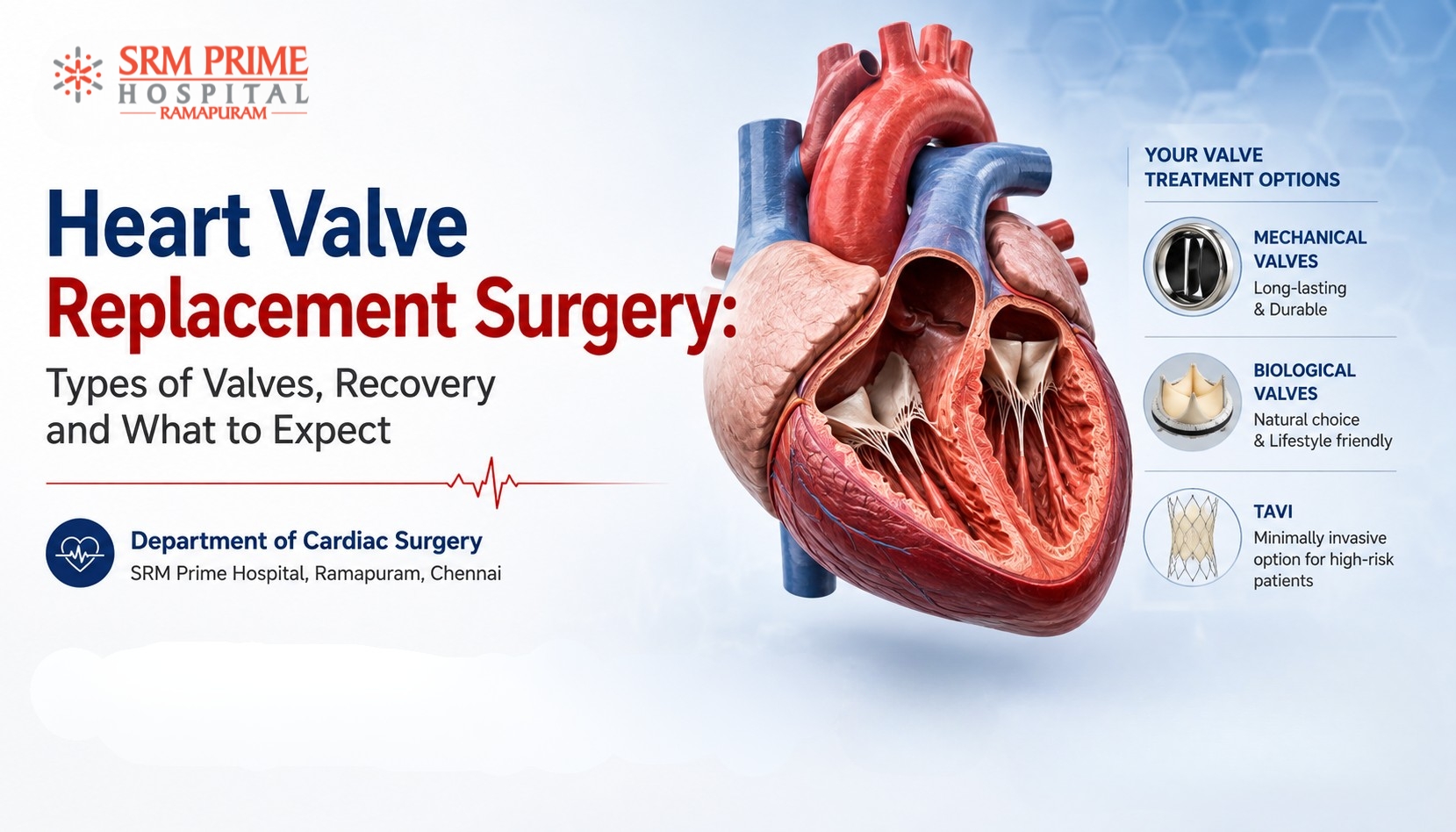
The heart has four valves that ensure blood flows in one direction through the heart's chambers. When a valve becomes too narrow (stenosis) or leaks backwards (regurgitation), the heart has to work harder to compensate, eventually leading to heart failure. Valve surgery — either repair or replacement — restores normal heart function. Modern techniques have made valve surgery safer and more effective than ever before.
Key Takeaways
- The aortic and mitral valves are most commonly affected and most commonly operated upon.
- Valve repair (when possible) is preferred over replacement — it preserves native tissue and avoids lifelong blood thinners.
- When replacement is needed, mechanical valves last longer but require lifelong warfarin; biological valves last 15–20 years but do not need warfarin.
- TAVI (transcatheter aortic valve implantation) — a catheter-based procedure — is now available for high-risk patients who cannot tolerate open surgery.
- SRM Prime Hospital's cardiac surgery team performs both surgical and transcatheter valve procedures.
The Most Common Valve Conditions:
Aortic Stenosis: Aortic valve narrowing; common in older adults and may cause chest pain, breathlessness, and fainting.
Mitral Regurgitation: Mitral valve leakage; may cause breathlessness, fatigue, and atrial fibrillation.
Mitral Stenosis: Narrowing of the mitral valve; commonly associated with rheumatic heart disease in India.
Aortic Regurgitation: Leakage of the aortic valve; may cause breathlessness and palpitations and is commonly associated with rheumatic disease.
Valve Repair vs Valve Replacement
When possible, surgeons prefer to repair the damaged valve rather than replace it. Valve repair preserves the native tissue, maintains better heart function, does not require lifelong anticoagulation (blood thinners), and avoids prosthetic valve-related complications. The mitral valve is most amenable to repair. If repair is not feasible, the valve is replaced with either a mechanical or biological prosthesis.
Mechanical vs Biological (Tissue) Valve Replacement
Durability: Mechanical – Lifelong (50+ years); Tissue – approximately 15–20 years.
Warfarin (Blood Thinner): Mechanical – Lifelong use is essential; Tissue – usually not required long-term.
Ideal Patient Age: Mechanical – generally preferred for patients under 60; Tissue – generally preferred for patients over 65.
Pregnancy: Mechanical – not ideal due to warfarin-related risks; Tissue – generally preferred for women of childbearing age.
Risk of Structural Failure: Mechanical – no structural valve deterioration; Tissue – small risk after 15–20 years.
Clicking Sound: Mechanical – an audible clicking sound may be present; Tissue – generally silent.
TAVI — Transcatheter Aortic Valve Implantation (For High-Risk Patients)
TAVI is a revolutionary catheter-based procedure that replaces a diseased aortic valve without open-heart surgery. A new valve — mounted on a stent — is delivered through a catheter inserted via the femoral artery in the groin. The new valve is positioned within the old valve and expanded, pushing the diseased leaflets aside. The procedure takes 1–2 hours under general anaesthesia or sedation, with no chest incision. Hospital stay: 3–5 days. Originally developed for very high-risk elderly patients, TAVI is increasingly being offered to intermediate-risk patients as the technology matures.
Recovery After Open Heart Valve Surgery
- Day 1–2: ICU. Breathing tube removed within hours in most cases.
- Day 3–7: Ward. Walking, breathing exercises, cardiac rehabilitation begins.
- Day 7–10: Home if recovery is uncomplicated.
- Week 2–6: Gradual activity increase. Sternal wound healing.
- Week 6–8: Driving and desk work resume.
- Month 3–6: Full recovery. Return to all activities.
Diagnosed with a heart valve problem? Our cardiac surgery and cardiology team at SRM Prime Hospital offers comprehensive valve assessment and both surgical and transcatheter treatment options. Call 044 3545 3545.
Book Appointment: srmhospitals.com | Call: 044 3545 3545 | Emergency: 044 3500 3500
Frequently Asked Questions (FAQ)
Do I need to take warfarin forever after mechanical valve replacement?
Yes. Mechanical heart valves require lifelong anticoagulation with warfarin (or a direct oral anticoagulant in some cases) to prevent blood clot formation on the valve. Regular INR blood tests are needed to ensure the dose is correct.
Can a biological valve be replaced when it wears out?
Yes. When a biological valve wears out (after 15–20 years), a second operation to replace it is possible. In many cases, a new valve can be placed within the worn-out valve using a TAVI-style catheter approach ('valve-in-valve' procedure), avoiding a second open-heart operation.
Is minimally invasive valve surgery available?
Yes. Minimally invasive mitral and aortic valve surgery — through smaller incisions (5–7 cm) or port-access techniques — is available for selected patients at SRM Prime Hospital. This approach offers faster recovery and better cosmesis compared to standard median sternotomy.
Can rheumatic heart disease be treated with surgery?
Yes. Rheumatic mitral stenosis can be treated with percutaneous balloon mitral valvotomy (PBMV) — a catheter procedure — in suitable cases, or with surgical valve repair or replacement. Rheumatic disease affecting multiple valves requires surgical correction.
What is the mortality risk of valve replacement surgery?
At experienced centres, the in-hospital mortality for elective aortic or mitral valve replacement is 1–3% for patients without other major health problems. Risk increases with age, reduced heart function, and the need for concurrent procedures (such as bypass surgery). A personalised risk assessment is performed pre-operatively at SRM Prime Hospital.






-vs-ESWL-Which-Procedure-is-Right-for-You.webp)







.webp)
.webp)

.webp)
+(1).webp)
.webp)